
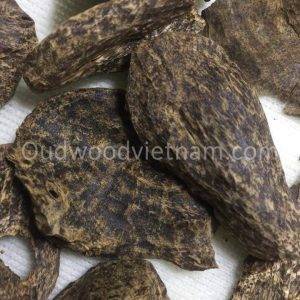
 Khanh Hoa Oud Wood Agarwood Chips | Chop Mu A | Grade A++ | 20g
 Subtotal: $200.00
Uncategorized
Sớ Gỗ Trầm (Resin Veins): How to Inspect Wood Grain with a Loupe
Resin Veins: How to Inspect Wood Grain with a Loupe
🖋️ Appraiser’s Note: As a Master Agarwood Appraiser based in Tu Son, Vietnam, I frequently receive questions about inspecting authentic resin grain structures. Let’s bypass the marketing myths and look at the physical facts.
The Verdict: Natural resin defies geometry.
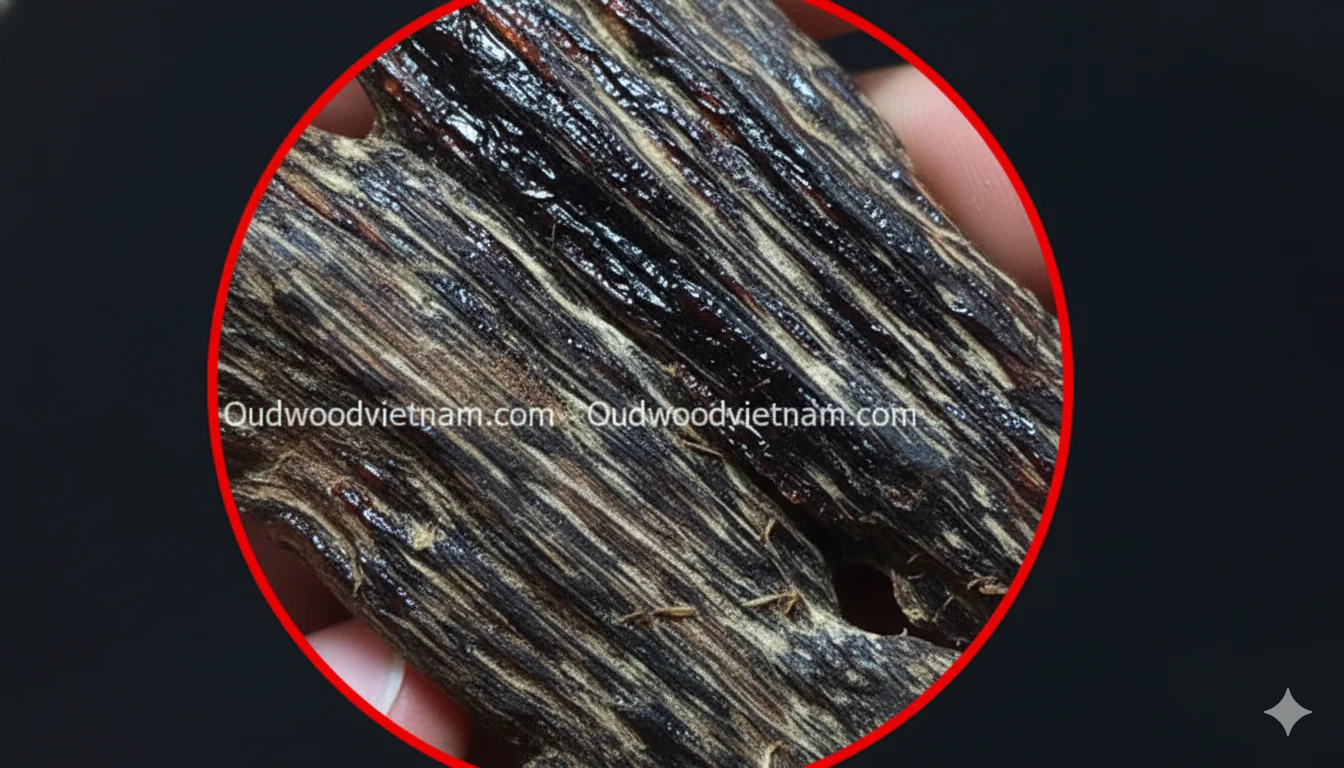
Authentic agarwood resin, or ‘Sớ Gỗ Trầm’, is never perfectly uniform. Under a 10x or 20x loupe, genuine resin deposits follow the organic, chaotic growth patterns of the Aquilaria Crassna tree’s vascular system. If you see perfectly symmetrical lines or ink-like bleeding that looks uniform across the grain, you are looking at a pressure-injected chemical fake. True resin is a biological defense mechanism, not a factory-printed pattern.
Thermal & Physical Analysis: The Tu Son Approach
When inspecting Resin Veins, the most critical factor is the relationship between the wood fiber and the oleoresin. In genuine specimens from the forests of Vietnam, the resin accumulates within the xylem, creating a distinct transition zone between the pale cellulose wood and the dark, hardened resinous tissue. When viewed through a loupe, the resin should appear translucent and layered, often reflecting light differently depending on the density of the infection.
Conversely, commercial-grade fakes are often created by boiling low-quality wood in synthetic oil or vacuum-pressurizing resin into the pores. Under magnification, these fakes reveal ‘bleeding’—the resin has soaked into the wood cells like dye into fabric rather than sitting as a mineralized deposit. Genuine resin will not smear or blur the edges of the grain; it will enhance the wood’s natural structure while maintaining the integrity of the fiber walls.
| Appraisal Feature | Authentic OudwoodVietnam (KNSI) | Fake / Commercial Grade (Chemical) |
|---|---|---|
| Resin Distribution | Irregular, biological, follows growth rings | Uniform, excessive, ‘painted’ appearance |
| Loupe Magnification | Translucent, crystalline resin deposits | Opaque, muddy, blurred grain boundaries |
| Fiber Integrity | Crisp, distinct wood grain visible | Softened, swollen, or chemically charred |
The Ultimate Solution: Trust the KNSI Standard
To avoid synthetic traps and ensure you are getting genuine investment-grade Aquilaria Crassna, you must rely on strict appraisal matrices. Read our complete 2026 Master Guide to the KNSI Standard to verify authenticity and protect your health and investment.

Oud Wood Agarwood Chips
Hoi An Oud Wood Agarwood Chips | Doi De A | Grade A++ | 20g
Oud Wood Agarwood Chips
Khanh Hoa Oud Wood Agarwood Chips | Chop Mu A | Grade A++ | 20g
Oud Wood Agarwood Chips
Natural Oud Wood Agarwood Chips | Mo | Grade A | 30g